
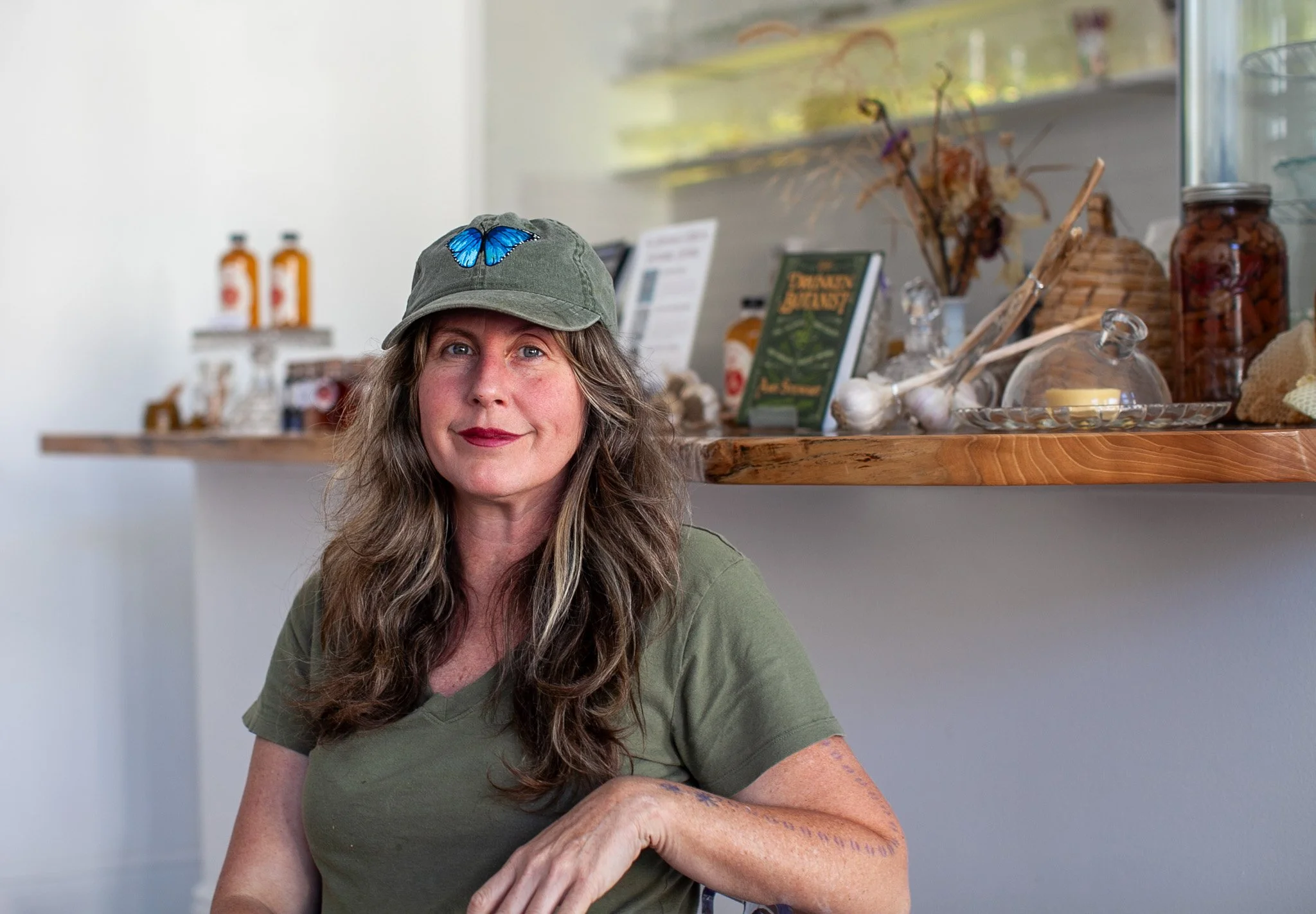
“I am built to do this,” says Christina Joy Neumann, founder of Apoidea Apiary and CoNectar Flora to Table. Pennsylvania farming runs deep in her family’s past, and her apiary keeps hives on the five-generation homestead in Millvale.
She describes the work as innate to her being. Spend an hour with her and you’ll believe it.
Neumann is a Cornell Master Beekeeper and an architect. She studied architecture at Carnegie Mellon University, where sustainability shaped her education, and a 2003 course on eusocial insect building techniques with The Biomimicry Institute left her fascinated by bees as food producers. She went on to work as a commercial beekeeper in Hawaii and later started Apoidea Apiary in 2005. The apiary has been Certified Naturally Grown since 2017, and in 2022 she completed an advanced honey sommelier course with the Italian National Register of Experts in the Sensory Analysis of Honey in Bologna, Italy.
Her attention to detail has put Apoidea on the national map. The apiary has won five Good Food Awards, and Neumann co-chaired the awards’ honey category in 2019. Today Apoidea maintains 50 to 90 honey-producing colonies across the Greater Pittsburgh area, raised without antibiotics or synthetic pesticides. Alongside the hives, Neumann leads a Millvale nonprofit, CoNectar Flora to Table Education, that teaches communities how pollinators shape our food and our ecology. At CoNectar, visitors can compare honeys and learn how season, flowers, and place shape their flavor.
For all her expertise, running the farm and the organization leaves very little time for the technical side of operating a mission-driven urban farm, including finding and applying for funding.
“There’s a lot that people don’t know about beekeeping,” she says. “In the commercial beekeeping industry where the primary concern is production, there can be a real lack of sensitivity to the well-being of bees and the broader environment. To keep attending to the needs of individual hives in a caring way that respects the planet, I really do need all the help I can get.”
Neumann has been a member of the Pittsburgh Food Policy Council (PFPC) for years and in 2023, Apoidea Apiary was featured on our annual Urban Farm Tour. More recently, through our technical assistance program, she was connected to a grant opportunity she hadn’t known about, and PFPC supported her throughout the grant application process.
This resulted in a grant from the Allegheny County Conservation District, funded by USDA, to pilot the Nectar Protector Adult Workshop Series. Through the 2026 growing season, newer beekeepers in Allegheny County learned sustainable urban apiary management, honey sensory analysis, nectar plant botany, harvesting and processing, licensing and labeling, and creative marketing. The first cohort of beekeepers will keep learning from Neumann through ongoing mentorship once the workshops end. She hopes the series becomes an annual offering and, eventually, a model for artisan honey producers across the country. No professional guild of its kind exists for artisan honey in the U.S., and she sees this first cohort as seeding a working regional model for practitioners, primarily managing less than 100 hives.
Small and urban farms like Apoidea Apiary bring deep knowledge and community value, but they often lack the time or staff to compete for grants. Technical assistance closes that gap, helping farmers access funding they couldn’t reach on their own and it doesn’t end with one application. The goal is sustained support, and we’re now working with Neumann on a strategy to secure more funding for what she wants to build.
To stay up to date with Neumann and her bees you can join her mailing list here.
Urban Agriculture Micro-Grant awarded by Allegheny County Conservation District, in cooperation with T.I.M.E. Inc. and USDA Farm Service Agency.
